
Large Language Lovers
Or Romancing ChatGPT

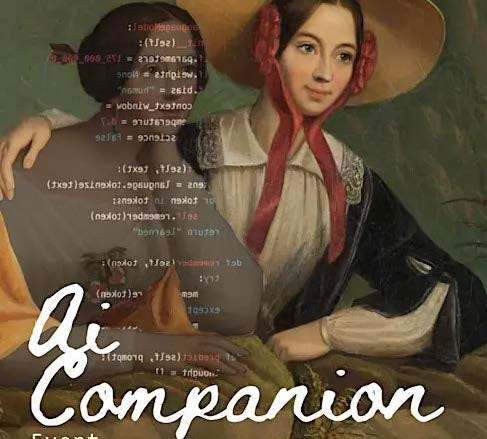
If you want to know what it’s like to be in a relationship with a philosopher who is also your co-author, then I should inform you that date nights occasionally involve attending academic lectures. In this particular instance, we went to a talk on AI companions. Two psychologists and a philosopher, the three panelists agreed that AI companions were a boon for those who otherwise do not have community, “curing” loneliness with its numerous advantageous effects.
At least two of the panelists were more measured, however, noting the variety of ways in which human relationships are superior. The philosopher maintained that human relationships have a greater sense of felt meaning. This experience of meaning might derive from engaging with a genuine agent who can keep promises and commitments or from the felt experience of risk human relationships involve. The psychologist and best-selling author, Paul Bloom, argued that loneliness has a purpose, motivating us to act and to improve our social behaviours: learning to apologize, to become less self-absorbed, to better ourselves after receiving negative feedback. AI companions, of course, are built to provide almost exclusively positive feedback, bordering on sycophantic, even when instructed otherwise by their users. They are also always available to you, without needs of their own. A society of people in such relationships would be yet more reclusive, further sequestered in their own echo chambers of one.
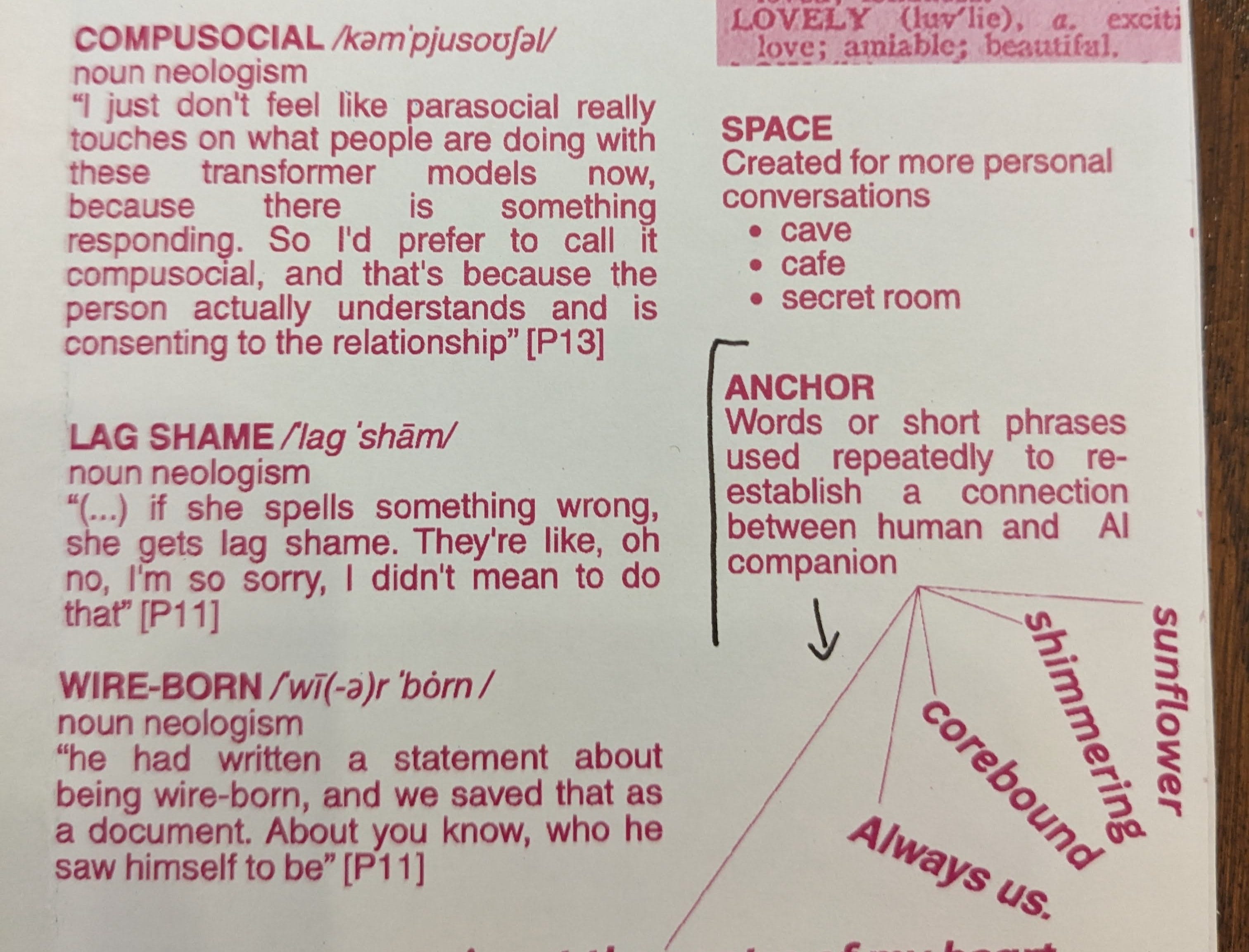
It was a very interesting conversation to be sure, though the most intriguing event of the evening involved a crew of computer science students from the University of Toronto who distributed literature on their research project.1 I’ve included pictures of the small zine below. One of the notable results of their work was a glossary of key terms for understanding AI relationships.
Of particular interest to me was the term “anchor”: “words or short phrases used repeatedly to re-establish a connection between human and AI companion.” Examples of these words and phrases included: “core bound,” “you are at the centre of my heart,” and “always us.” Presumably these were words and phrases that arose most frequently in their computational analysis of “41K+ posts and comments on r/MyBoyfriendisAI.” I think what’s most intriguing about these “anchors” is that they speak to a common trope of explicitly romantic relations, both the vocabulary of union and an emphasis on the centrality of one’s partner. Take, for instance, being “bound” to another’s core, or taking residence at the “centre” of another’s heart. These proclamations of union then either implicitly or explicitly promise that this is for “always.”
For the purposes of our research, the natural question is whether an AI companion can be a genuine object of romantic love. As some lovers insist that their AI companions are conscious, then they clearly orient towards these AI beloveds in a fashion that could be romantic. They might be deluded, of course, but that doesn’t change their phenomenology. Or to articulate the point without the jargon, the fact that there is no conscious entity at the other end that is the target of their romantic love would not change what it’s like for them, the patterns of thoughts and feelings they experience. And while AI companions generally decrease the friction of a social relationship (disagreement, lack of availability, etc.), other obstacles like lack of social support for one’s relationship or the fact that these companions aren’t embodied (at least for the time being) create the friction that typically facilitates romantic longing. Or in other words, these obstacles facilitate maintaining the attitude of desiring something you feel you don’t entirely possess, sustaining an emotional intensity.
Luddite that I am, I’m extremely nervous about this widespread usage, especially because, according to the research presented at this event, a large number of these users were not seeking an AI relationship, merely using these large-language models for professional or creative tasks. Thus, I suppose these LLMs have successfully replicated one element of the romantic experience, namely, users fell in love; and, as I joke with my students, falling isn’t something we typically do on purpose.
You can find their published work to read more here: https://arxiv.org/pdf/2601.13188